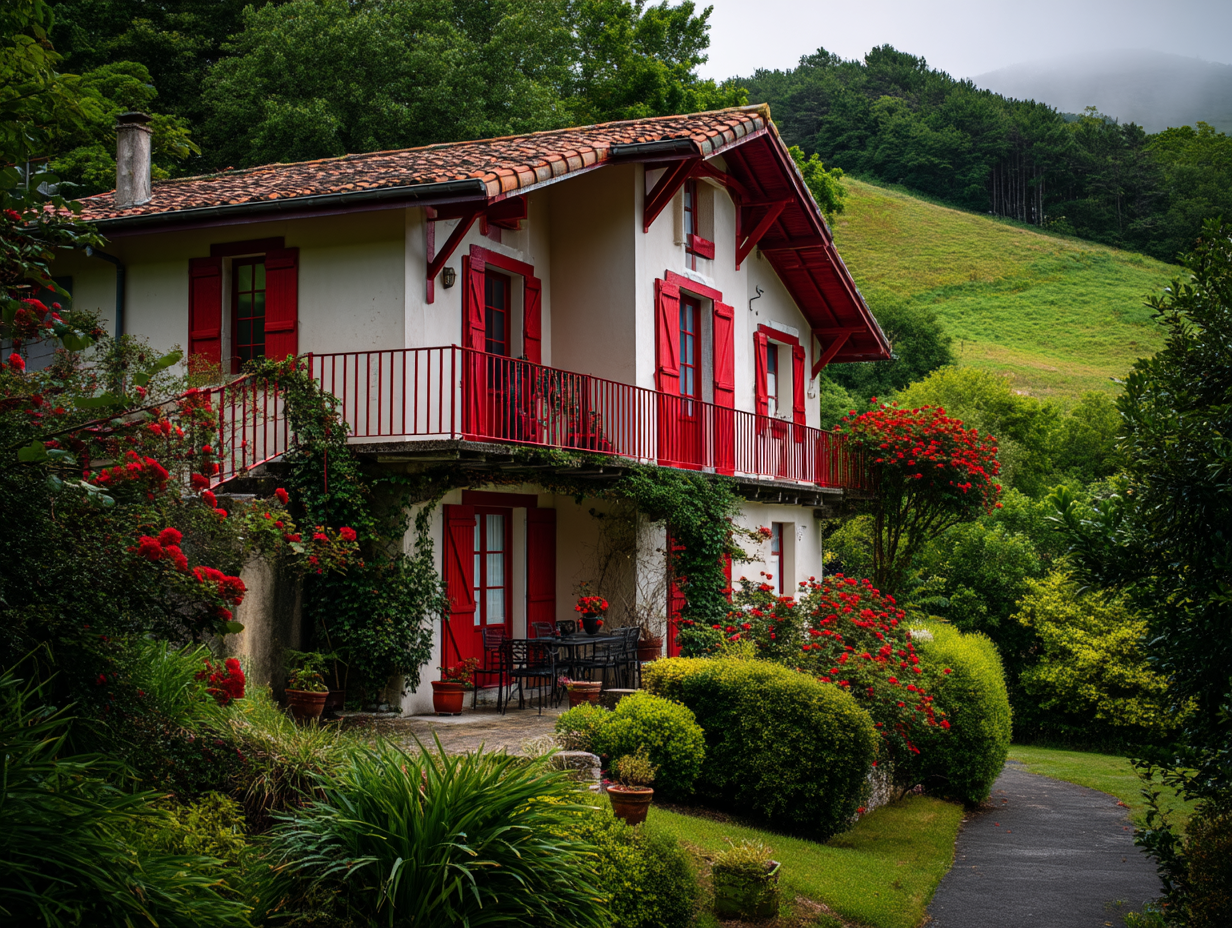
An oxblood red, limewashed façades, timber beams that shape the identity of an entire region… Renovating a Basque home is not just a matter of taste. It is also a matter of rules, heritage, and local nuances. Better to understand it all before choosing your shutters!
All it takes is a walk in Saint-Jean-de-Luz or Bayonne to feel that every Basque house has its own character. Here, a red colour that evokes pastoral traditions; there, wooden shutters opening onto limewashed façades. This charm we love so much is no accident. It is the result of a very specific regulatory framework, designed to preserve the architecture of Basque houses.
You might think it is enough to pick a shade from a colour chart or repaint your windows with a bit of paint and a lot of enthusiasm. But no. There are rules—sometimes strict, often little known—that govern joinery work throughout the Basque Country region—and even in certain municipalities in Les Landes. Between the local urban plan, the Architects of the Buildings of France, and obligations linked to the prior works declaration, it is best to know where you are putting your paintbrush.
This article is not intended to scare you (though it might). The idea is rather to share the right reflexes, a few local anecdotes, a touch of culture, and one or two tips to avoid the most common mistakes. And if you feel the paint going to your head, La porte Basque is here to support you in choosing compliant, beautiful, and durable joinery.
One region, one identity: colour as an architectural signature
The Basque house, a heritage to preserve
It is impossible to pass through a village like Ascain, Sare, or Espelette without falling under the spell of these powerful, welcoming Basque houses. Large white façades, exposed timber beams, colourful shutters like a nod to the past—everything seems unchanging, almost timeless.
But what we perceive as a “typical” style actually rests on a finely codified balance, shaped by history, customs… and regulations. Basque house architecture is not improvised. It is respected. It is inherited, sometimes even in silence.
In most homes in the Basque Country, you find this brilliant whiteness, achieved thanks to lime, once used to protect stone walls and repel damp. These limewashed façades are still a reference today, like a common thread between generations.
Oxblood red, far more than a simple paint choice
It is called “oxblood”, this almost matte deep red, typical of Basque shutters and exterior joinery. Its origin is said to date back to a time when slaughterhouse blood was mixed into linseed-oil-based paint to protect wood from bad weather and insects. Hence this name, as surprising as it is poetic: oxblood red.
This very distinctive tone—neither burgundy, nor carmine, nor brown—has become a visual signature of homes in the Basque Country. It evokes solid timber beams, sturdy shutters, and sometimes even barns converted into family homes. The red of exterior joinery naturally pairs with the whiteness of façades, in a perfectly embraced play of contrasts.
But be careful: not every shade will be accepted. A red that is too bright, wood that is too varnished, or a satin paint can offend the eye of the Architects of the Buildings of France (ABF) and jeopardise your approval.
Why shutters are not chosen at random
Replacing your shutters or repainting your façades is no small matter in this part of France. In protected areas or in municipalities subject to a Local Urban Plan, the prior works declaration becomes mandatory—sometimes even the opinion of the ABF. That is where problems begin if you are not supported.
An example? In Saint-Jean-de-Luz, a resident had to redo her entire façade renovation after choosing a shade deemed “too contemporary” by the town hall. The result: costs doubled, the site put on hold, and neighbours a little too pleased to quote the rules to the letter…
What does the local urban plan say in the Basque Country?
Planning rules to know before any project
Behind every shutter shade, every repainted timber beam, every façade renovation, there is a somewhat dry… but essential document: the Local Urban Plan (or PLU for those in the know). It sets the codes to follow for homes in the Basque Country—and sometimes even the façades of Landes houses, in certain municipalities on the edge of the area.
In this document, everything is covered: materials, permitted shades, wall heights, finishes… A real user guide for completing your joinery work or façade painting without unpleasant surprises. It may be tempting to ignore it, but honestly, we do not recommend it. Even for a simple change of shutter colour, the PLU can impose specific shades or prohibit certain ones (flashy blue? Very unpopular in Ascain…).
👉 To consult your municipality’s PLU, you can use the Géoportail de l’urbanisme, an official website that centralises documents for more than 20,000 municipalities in France. A real goldmine… if you know what to look for.
The prior works declaration: a mandatory step
No, repainting your windows bright red is not something you do between two morning coffees. As soon as you change the exterior appearance of a building, a prior works declaration must be filed. And this, before you take out the paintbrushes. This administrative step allows the municipality to check that your project respects the local spirit. In short, that your home stays in keeping with the Basque Country palette of red, white, and wood.
The form to complete (the famous Cerfa no. 13703) may seem harmless, but it carries responsibilities—especially if your home is located within the perimeter of a remarkable heritage site or a historic monument. In that case, the opinion of the Architects of the Buildings of France becomes mandatory. And then, it is fair to say you do not negotiate with an off-spec RAL.
The role of the Architects of the Buildings of France (ABF)
The ABF, those well-known Architects of the Buildings of France, ensure architectural coherence in sensitive areas. Their mission? Preserve the harmony of Basque houses, avoid visual discord, and enforce a certain idea of the regional built landscape.
They step in as soon as a project affects a protected area—which is common in Bayonne, Biarritz, Saint-Jean-de-Luz, or any village with intact charm. They give an opinion on the choice of colours, the type of joinery, materials, shapes…
You can consult the recommendations and the exact role of the ABF on the official website of the Ministry of Culture. A valuable source if you like to understand before you act.
Colours, yes—but not just any colours
Permitted shades for exterior joinery
We all dream of a free choice of colour, like a blank canvas to personalise. But in a Basque house, reality is a little more structured. It is not a constraint; it is continuity. You work with regional codes, local materials, the habits of earlier generations, and sometimes even the neighbours.
Here are a few reference points, gathered from local urban plans, recommendations from the Architects of the Buildings of France, and field feedback:
– Oxblood red remains the must-have. It dresses shutters, doors, and sometimes timber beams on the façade.
– Dark greens (such as pine green or fern green) are often permitted in the villages of Labourd.
– Basque blue—deep, leaning towards ink—can sometimes be found by the sea, notably in Saint-Jean-de-Luz.
– Anthracite grey may be accepted, but mainly in newer residential areas, not in the historic centre.
– Untreated or stained wood is sometimes tolerated, provided you avoid the Alpine chalet effect…
The key? Stay within a range of natural, understated shades, often matte, that work with limewashed façades and the surrounding environment.
Which colours should you avoid to prevent being rejected?
The temptation to modernise, create contrast, and dare a design touch is strong. Yet there are a few pitfalls to avoid:
– Garish colours (lemon yellow, turquoise, candy pink…) are systematically refused.
– Glossy or lacquered finishes clash with the matte look of traditional paints.
– Metallic tones or a “brushed aluminium” effect do not pass in protected areas.
The choice of façade colour is never purely aesthetic. It reflects a connection to the area. Red, wood, and white are not trends: they are markers of Basque house architecture.
Wood: a noble material, but closely monitored
Wood, omnipresent in Basque house architecture, must also follow certain codes. Solid-wood exterior joinery is often appreciated, provided it is well finished and properly maintained. But be careful not to use just any wood, or just any finish.
For example, green pressure-treated pine may be rejected. It is better to favour local species or stained woods in discreet tones. Here again, the local urban plan provides valuable guidance.
And if you wish to opt for aluminium or PVC joinery? It is sometimes possible, provided it faithfully imitates the look of traditional wood. In short, it is best to seek advice from a local professional, such as La porte Basque, before ordering your windows from a catalogue.
Your joinery: how to combine style and compliance
What a local professional can genuinely help you avoid
When you live in the Basque Country, you quickly learn that planning has its rules—but also its subtleties. And as part of a renovation project, the risk is not so much doing things wrong as believing you can improvise. A forgotten form, a misread shade, a doubt about the prior works declaration… and the file remains blocked.
A local professional who knows the local urban plan and the practices of municipalities such as Bayonne, Biarritz, or Saint-Jean-de-Luz can literally change everything. They anticipate, interpret, and adjust. They know, for example, that the same shade may be accepted in Arcangues but refused in Bidart. They have seen dozens of files, sometimes rejected over a handful of nuances.
And then there are the materials. The choice of joinery is not limited to a matter of taste. You must work with what is already there, the timber beams, exposure, and climate conditions. Honestly, this expert perspective is a luxury that avoids a lot of trouble.
Tips for making the right choices without stress
Replacing your shutters, your windows, or redoing your house façade is not just ticking a technical box. It is an opportunity to enhance your property, reconnect it with its history, and strengthen its roots in the Basque Country.
A few simple pointers to get started:
– Do not choose the colour before checking the PLU
– Do not sign a quote before confirming regulatory feasibility
– Plan for matte or natural finishes
– Choose shades in harmony with neighbouring houses
– Prefer a tradesperson who knows the area and the administrative process
It is a bit like cooking a local dish: you can follow the recipe, but nothing beats the intuition of a local chef.
Quick useful reminder
For those who want to go further:
– The Géoportail de l’urbanisme website allows you to consult your municipality’s rules (by entering your home address).
– The Ministry of Culture website on the ABF details protection perimeters and the ABF’s missions.
But honestly, if you have better things to do than dive into 60 pages of regulatory jargon, there is a more direct alternative: simply ask La porte Basque for advice.
Why contacting La porte Basque really changes everything
Local expertise
Here, in the Basque Country, people do not take houses lightly. Each one has its roots, its look, its small details—often invisible at first glance but decisive for the Architects of the Buildings of France. Navigating between planning, tradition, and permitted shades… requires know-how you will not find in big chains or on automated quote platforms.
La porte Basque is a team rooted here, between the Atlantic and the hills of Iraty AOP, between Bayonne and the valleys of Soule. They are craftspeople who speak your language—and that of your PLU.
Tailored support
Are you hesitating between oxblood red and a deep green? Wondering whether stained wood will be accepted in your neighbourhood? Not sure whether your project falls under a prior works declaration? Just ask. No need to be a pro in Basque house architecture: that is what we are here for.
The first contact is a conversation—an exchange to understand what you envision, what you like, and what your home can accommodate. Then we guide you: choice of joinery, shades, feasibility validation, right through to filing the application if needed.
We do not sell a window. We restore coherence to your façade, respecting the rules without betraying your style.
Finishes that respect the rules… and your preferences
The challenge is always to combine modern comfort with heritage aesthetics. Insulate without altering. Modernise without shocking. The choice of materials, colours, shapes—everything is examined closely. The goal: for your work to be approved, durable… and beautiful.
By choosing La porte Basque, you save time, gain peace of mind, and that little thrill you feel when you see your home transformed… without losing any of its soul.
Replacing your joinery in the Basque Country is not simply about improving insulation or enhancing a façade. It is about becoming part of a landscape, extending a story, passing on a style. A poorly chosen colour, a misunderstood finish, and the harmony of an entire neighbourhood can be disrupted.
Fortunately, you are not alone when faced with colour charts and endless regulations. Sometimes it is enough to surround yourself with the right people: a trained eye, sound advice, a professional who understands both planning, the material, and what you envision—often between the lines—for your home.
La porte Basque is not just a joiner. It is a local ally, a conduit for elegance, a translator between your wishes and your municipality’s requirements.
Take the time to ask your questions and request a quote. This first step commits you to nothing, except doing things properly.
Want to renovate without stress, while respecting Basque style?
Our team supports you in choosing joinery and permitted shades. A clear quote, a well-structured project, a home that reflects you.